Zhonghe Ancient Town · Wuding Gate (on-site photo, Nov 2026)
Most "ancient towns" got their name first, and their story later.
Not this one.
In Danzhou, a place began building its walls in the fifth year of Tang Wude (622) and did not lose the county seat until the tenth year of the Republic (1921). All told, it served as the seat of Danzhou Prefecture for about 1,300 years.
Nowhere else on Hainan held the title of "prefectural seat" for so long.
It is now called Zhonghe Town. A population of over twenty thousand, a farming place.
In November 2026, we went early in the morning. The city gate, the old temple, and the stone pagoda are all still there — just no tourists.
First, what it looks like now
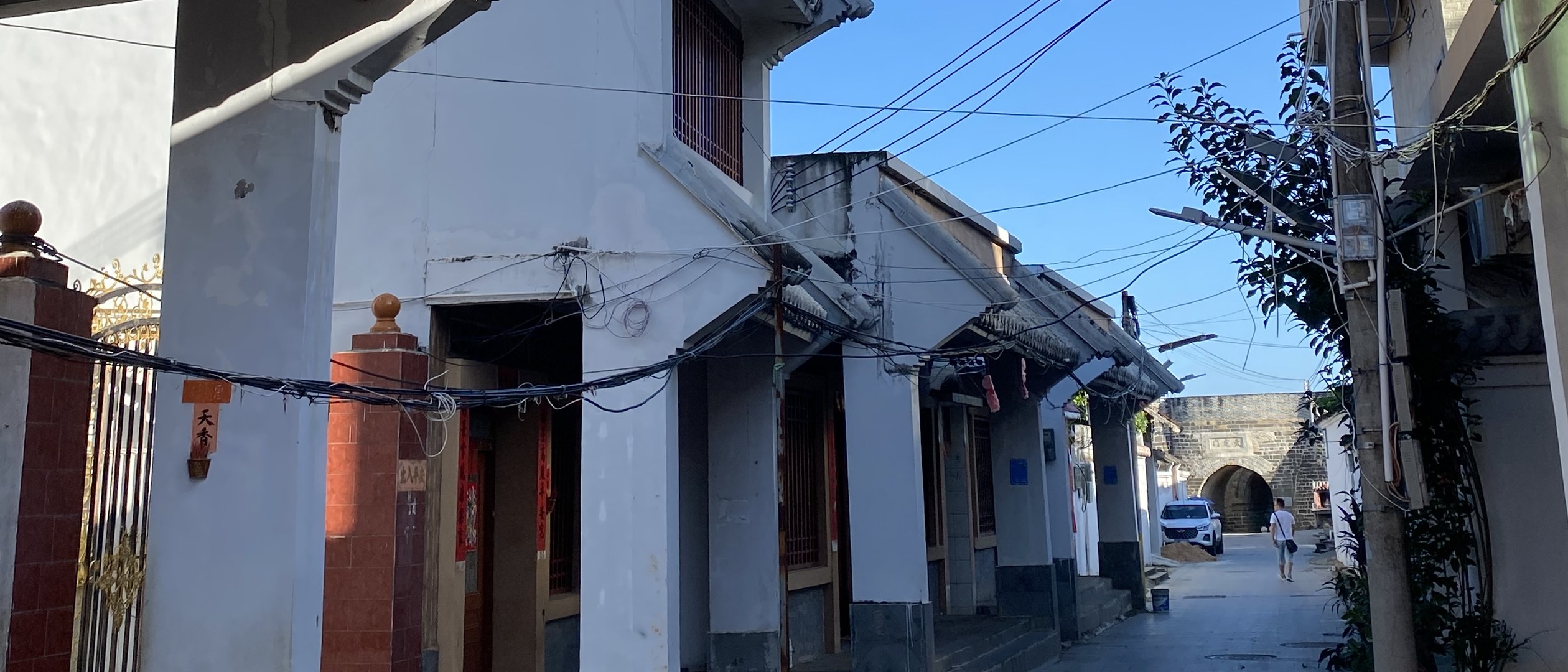
The north gate is called Wuding Gate. Its blue-brick arch still stands, and the three characters "武定门" on the lintel are clear.
We arrived just after eight in the morning. Old folks in town rode electric scooters in and out of the arch, to the market, to the fields. No one looked up at the gate.
To tourists it is a relic; to them it is simply the road they walk every day.
A prefectural seat for 1,300 years
In the fifth year of Tang Wude, Dan'er Prefecture became Danzhou Prefecture, and the seat moved to Zhonghe — then called Yilun, and even earlier Gaopo. From then on, through Song, Yuan, Ming and Qing, until the county seat moved to Xinzhou in the tenth year of the Republic, this was always where the Danzhou prefectural seat stood.
For 1,300 years, the government offices, schools, temples and markets all turned around this city.
The wall was first rammed earth, clad in brick and stone only in the Ming dynasty. In the sixth year of Hongwu (1373), four gates were opened: east Dehua, south Rourou, west Zhenhai, north Wuding.
Of the four gates, only two remain: the north Wuding Gate and the west Zhenhai Gate.
(By the way: Zhenhai Gate is not yet developed on site, and this time we only photographed Wuding Gate.)
Hainan's earliest Lady Xian temple, in the town center
The oldest temple in Zhonghe is the Ningji Temple.
Built in memory of Lady Xian, it dates from the Tang dynasty and is the earliest Lady Xian temple on Hainan.
Lady Xian lived from the Northern and Southern Dynasties into the Sui and Tang. She devoted her life to pacifying Lingnan and upholding unity. Premier Zhou Enlai called her "a famous heroine in our history."
In the Shaoxing era of the Song dynasty, the court titled Lady Xian "Lady Xianying," named this temple "Ningji," and Emperor Gaozong (Zhao Gou) personally inscribed the plaque.
The temple still keeps the Taipo Well, nine stone carvings of Li chieftains, and Qing-dynasty stone steles.
The nine carvings kneel before the screen wall, telling the story of Lady Xian pacifying Hainan and more than a thousand Li settlements submitting. Interestingly, one in the middle differs from the other eight — the others kneel with hands clasped; this one kneels with hands behind its back. Locals say it is the Li chieftain who, even after defeat, still refused to submit.
Over a thousand years later, that gesture of "not submitting" is still there, in stone.
A seven-meter stone pagoda, standing in a primary school
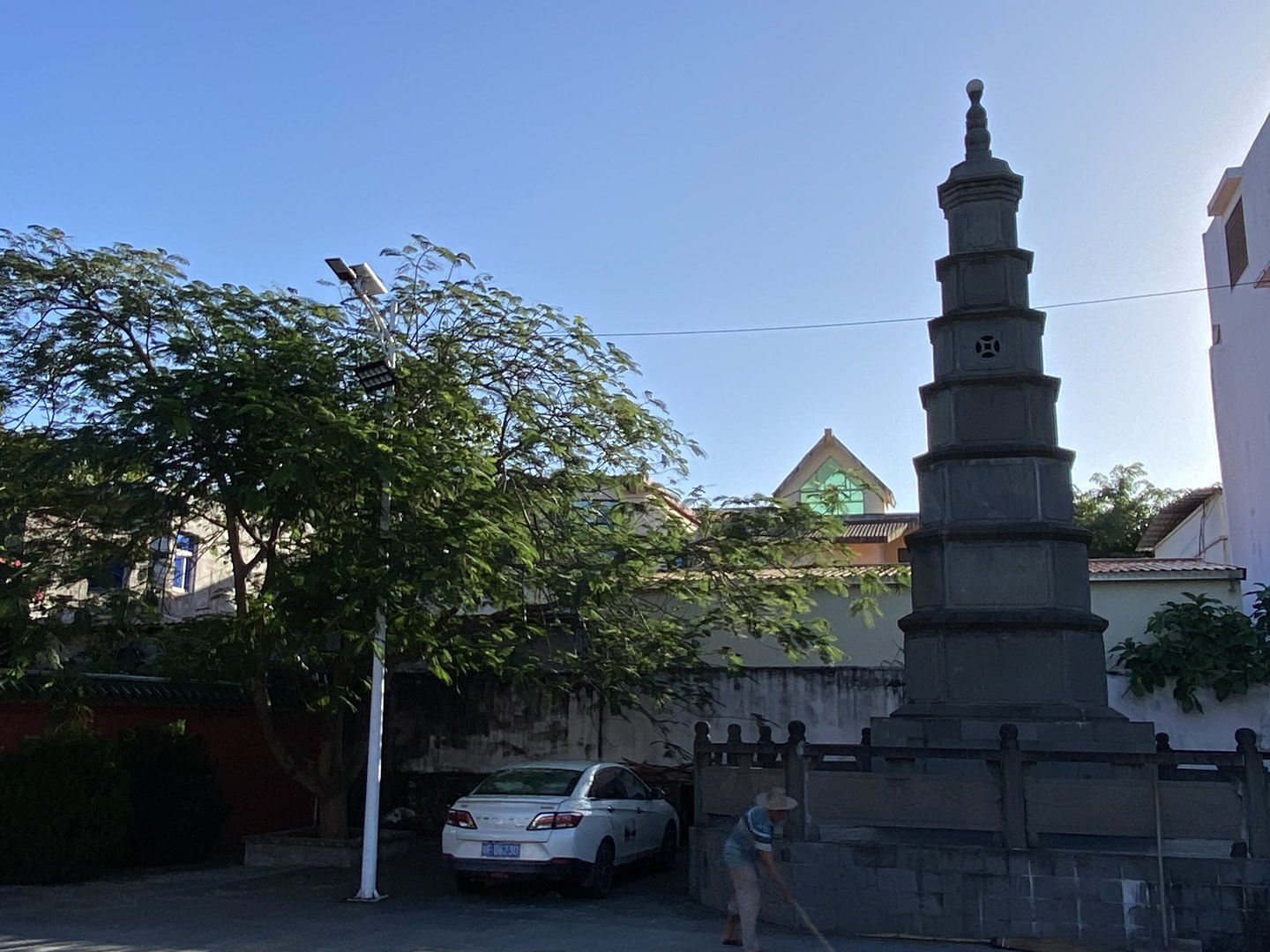
The Kuixing Pagoda is hidden inside a primary school.
It is a stone pagoda built of basalt from volcanic eruptions, seven storeys tall, 7.02 meters high. First built in the Ming dynasty, it was rebuilt in the twenty-first year of Guangxu (1895).
The pagoda is for "Kuixing," the first star of the Big Dipper, which the ancients said governs the rise and fall of literature — building it was a wish for more scholars from this place.
Stone pagodas are rare on Hainan. This one is a provincially protected cultural relic and a living specimen for studying Ming-dynasty stone pagoda architecture.
The first storey has a small arch facing south, too narrow to enter; the fifth storey has a coin-shaped window facing north. A seven-storey stone pagoda, quietly standing in the corner of a primary school.
Fuxing Street: arcade houses from 1923
Zhonghe has an old street called Fuxing Street, first built in 1923.
The street is paved with bluestone, and the arcade houses on both sides are in the Nanyang (Southeast Asian) style — the same school as the Haikou arcade old street. In western Hainan, such an arcade street is rare.
The day we went, the street was hung with red lanterns, the shops still open, selling daily sundries.
A century-old street that never became a commercial street — still what it always was.
Su Dongpo lived here for three years
You cannot talk about Zhonghe without Su Dongpo.
In the fourth year of Shaosheng (1097), Su Shi, then in his sixties, was banished to Danzhou and lived in Zhonghe. Over three years he dug wells, encouraged farming, and opened schools — and from then on Hainan began to produce juren and jinshi degree holders.
Zhonghe has the ruins of the Guanglang Hut — when Su Shi first arrived, driven out of official lodgings, he built a thatched hut in the guanglang palm grove south of the city. Beside it is Dongpo Well, said to have been dug by him, its rim worn with notches from years of use.
(This time we only photographed the Guanglang Hut from a distance; we did not go inside.)
An ancient city gains another layer of color because of one person.
In the end
Most ancient towns written into travel guides are no longer themselves — selling the same squid, hanging the same signboards.
Zhonghe is different.
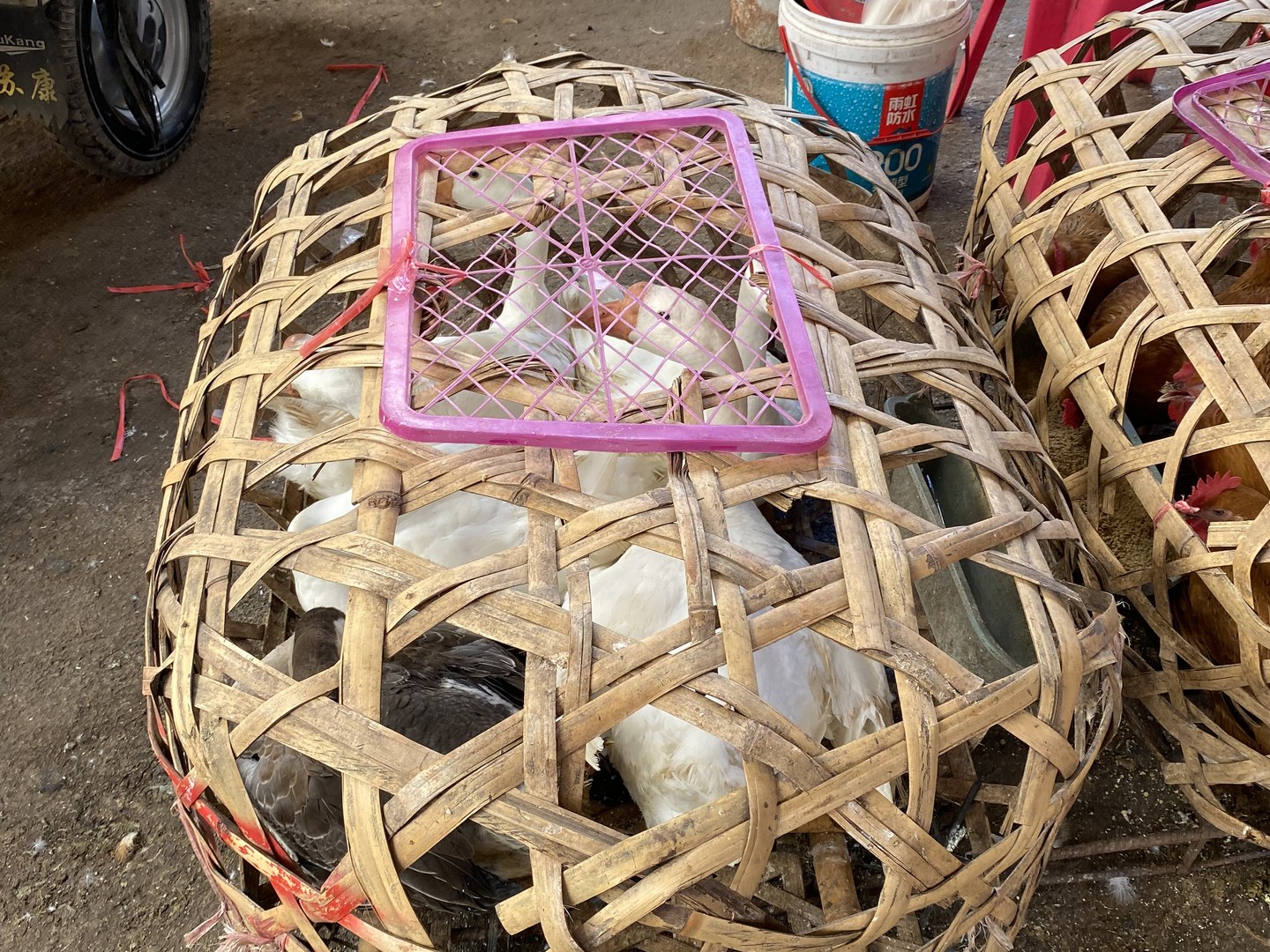
It was a prefectural seat for 1,300 years, and today it is a quiet farming town. People still walk through the gate, incense still burns in the temple, a stone pagoda still stands in a primary school, and bamboo-woven chicken cages still sit at the market.
The daily life of its residents is the best look this ancient town has.
海南儋州 · 海花岛